

Connect Claude, ChatGPT and other AI agents
OneBooks runs an MCP server (Model Context Protocol), so the AI agents you already use can work on your books: pull reports, look up records, search this documentation and prepare documents that you confirm. They get exactly the tools the in-app assistant has, under the same rule — nothing is written until a human approves it.
Pick your client
Section titled “Pick your client”Cursor, VS Code, the MCP Inspector and custom agents connect the same way — see the section on other MCP clients below.
What you need
Section titled “What you need”- A OneBooks account. The agent inherits your role: a viewer gets read-only tools, a member can propose documents, and only an owner or admin can propose payments.
- Claude and ChatGPT reach OneBooks from their own servers; Claude Code and OpenClaw connect from your computer. Either way the client signs in through the consent screen below — never with a pasted key.
Approve access
Section titled “Approve access”The first time a client connects, OneBooks opens its sign-in and consent screen.
- Sign in with your OneBooks email and password if you are not signed in already.
- Check the business named on the screen — access is granted for your active business only.
- Review what the app will be able to do, then select Approve (or Deny).
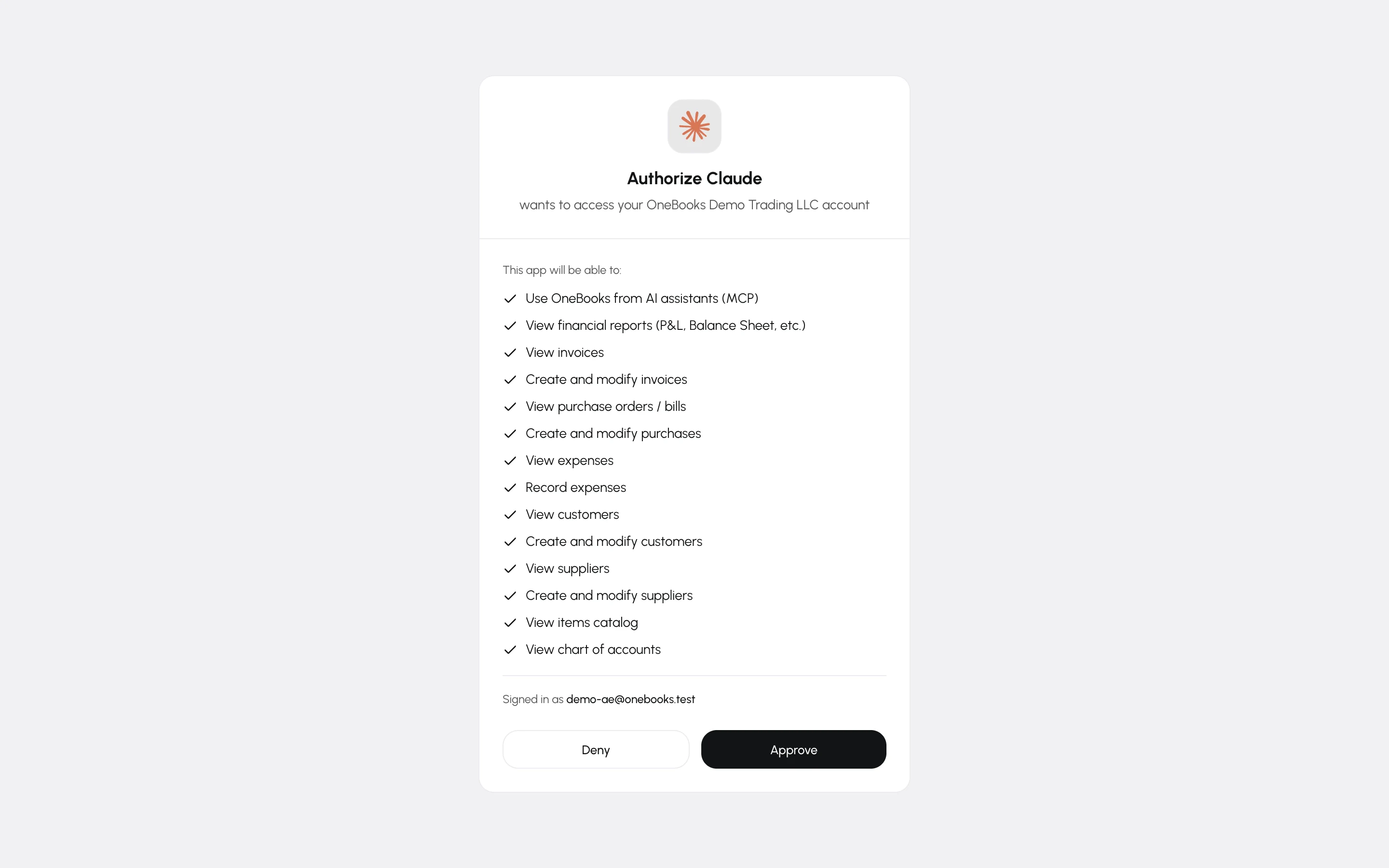
Switching your active business in OneBooks ends the connection; connect again and consent for the new business.
Claude
Section titled “Claude”Custom connectors are available on every Claude plan (the free plan allows one). Claude connects to OneBooks from Anthropic’s servers, so a connector added once works in the browser and in Claude Desktop alike.
- Open Customize → Connectors. On Team and Enterprise plans an owner adds it under Organization settings → Connectors → Add → Custom; members then select Connect.
- Select Add custom connector, name it OneBooks and enter
https://api.getonebooks.com/mcp. Leave the advanced OAuth fields empty — Claude registers itself. - Select Connect and approve access on the OneBooks screen.
- In a chat, open the + menu, choose Connectors and switch OneBooks on. Then ask: “What is my cash position?”
Claude Code
Section titled “Claude Code”Register the server once for all your projects, then sign in from the /mcp panel:
claude mcp add --transport http onebooks --scope user https://api.getonebooks.com/mcpInside Claude Code run /mcp, choose onebooks and finish the sign-in in the browser. claude mcp list shows the connection and claude mcp remove onebooks removes it. Claude Code identifies itself with a client metadata document, so there is nothing to register.
ChatGPT
Section titled “ChatGPT”Custom MCP servers in ChatGPT need Developer mode, available on Plus, Pro, Business, Enterprise and Edu plans (a workspace admin may have to allow it first). Set it up once on the web; the connector belongs to your ChatGPT account.
- Open Settings → Apps (named Connectors on some plans), then Advanced settings, and turn on Developer mode.
- Select Create, name it OneBooks, enter
https://api.getonebooks.com/mcp, choose OAuth as the authentication and confirm that you trust the provider. - Approve access on the OneBooks screen.
- In a new chat select + → More → Developer mode, enable OneBooks for that conversation, and ask away.
Without Developer mode, ChatGPT uses only two read-only tools — search and fetch — which find and quote your invoices, purchases, customers, suppliers and items, for example in deep research. Reports and drafting need Developer mode.
OpenClaw
Section titled “OpenClaw”OpenClaw is an open-source personal agent that runs on your own machine and talks to you through your messaging apps.
- Open Settings → MCP, select Add server, name it
onebooks, choose the Streamable HTTP transport and enterhttps://api.getonebooks.com/mcp. - Set the server’s authentication to OAuth (the configuration entry is shown below).
- Run
openclaw mcp login onebooks. The browser opens the OneBooks consent screen and OpenClaw stores the tokens; if the browser cannot reach OpenClaw’s callback, use the--codecommand it prints. openclaw mcp status --verboseconfirms the connection.
In OpenClaw’s configuration file the server entry reads:
{ mcp: { servers: { onebooks: { url: "https://api.getonebooks.com/mcp", transport: "streamable-http", enabled: true, auth: "oauth", }, }, },}Other MCP clients
Section titled “Other MCP clients”Any client that supports Streamable HTTP and OAuth 2.0 with PKCE can connect — Cursor, VS Code, Windsurf, the MCP Inspector, custom agents. Where the client takes a configuration file, the entry is:
{ "mcpServers": { "onebooks": { "type": "http", "url": "https://api.getonebooks.com/mcp" } }}The client discovers the sign-in server, registers itself (or presents its client metadata document) and opens the consent screen.
What the agent can do
Section titled “What the agent can do”Exactly what the in-app assistant can: reports and lookups, answers from this documentation, and proposals for invoices, purchases, expenses, payments, customers and suppliers.
Writing works in two steps here too. The agent asks OneBooks to prepare the document; OneBooks stores a proposal and returns a preview, which the agent shows you. Only after you approve that exact preview does the agent confirm the proposal — never in the same turn, once only, and within 24 hours. Every proposal also appears in the in-app assistant, where you can confirm or cancel it yourself. There are no delete, void, edit or refund tools for any agent.
Manage and revoke access
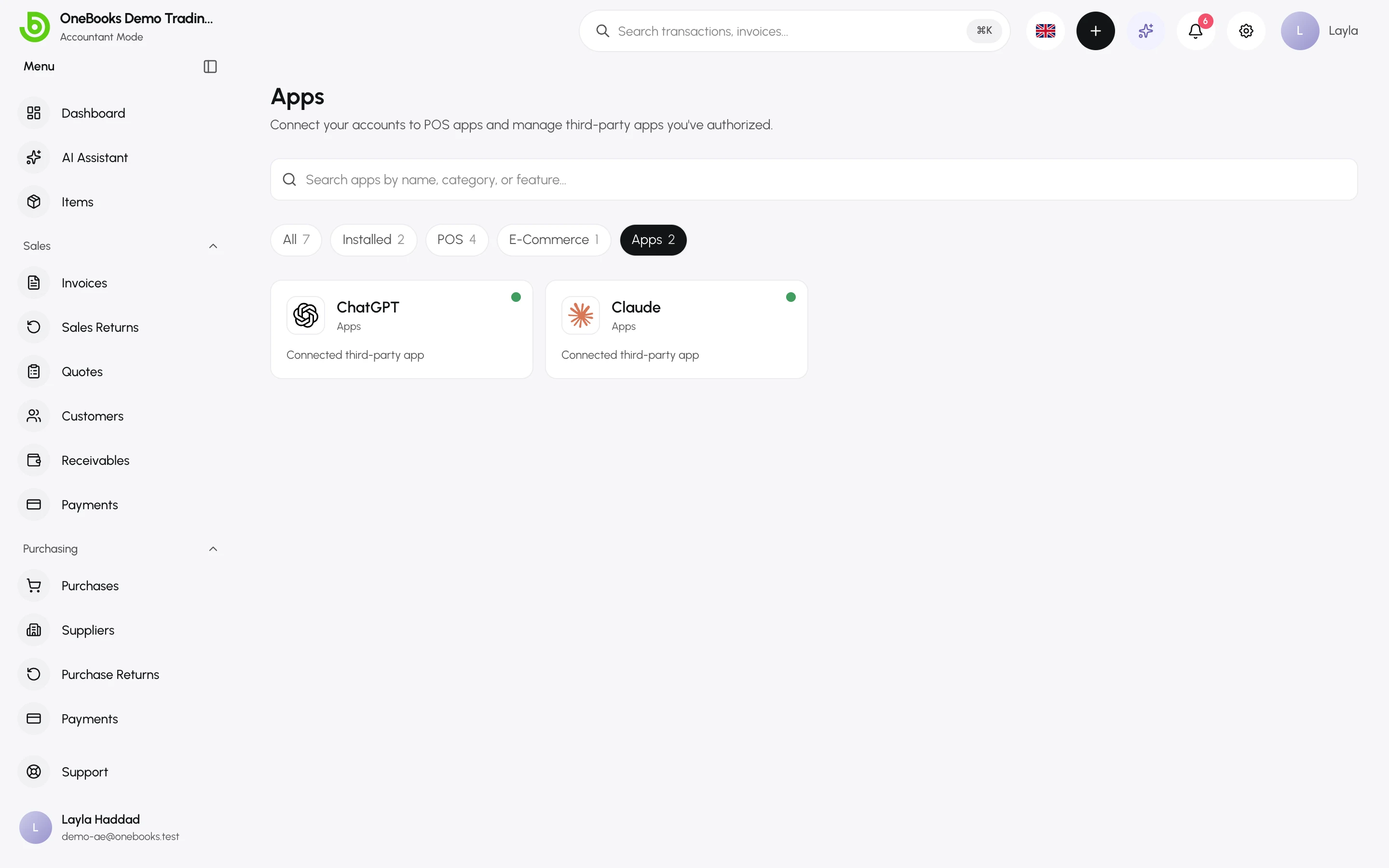
Section titled “Manage and revoke access”Apps → Apps with the Apps filter lists the AI clients connected to your business, each with its own name and mark, when it was authorised and when it was last used.
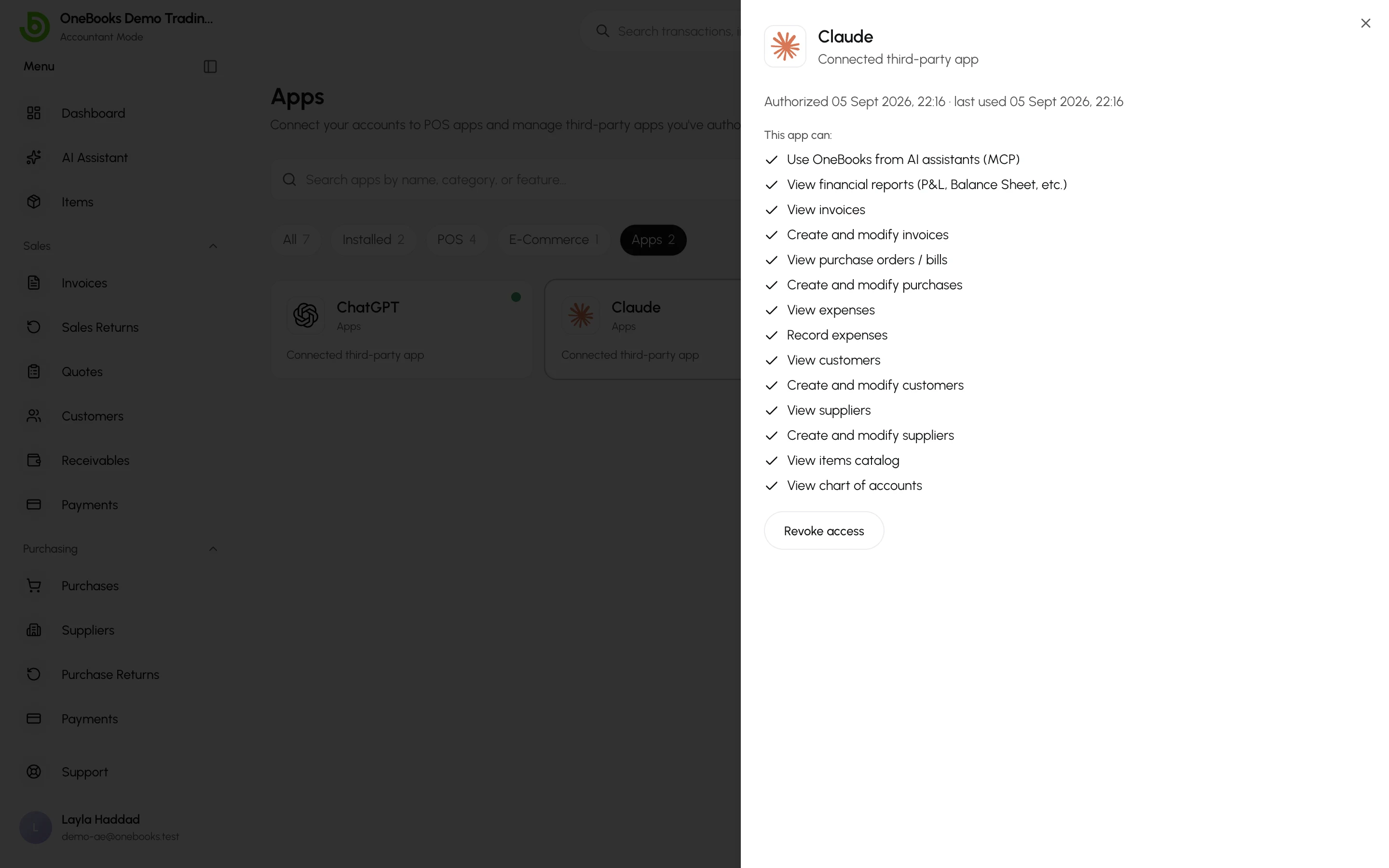
Select a card to see what the app can do and to Revoke access. Its tokens stop working immediately; nothing it already created is removed.
Limits
Section titled “Limits”120 requests per minute per address, a weekly call cap per business, and the shared weekly credit allowance. See Credits and limits.
Troubleshooting
Section titled “Troubleshooting”- The consent screen names the wrong business — switch your active business in OneBooks first, then connect again.
- The client stopped working after you switched business — expected; connect again and consent for the new business.
- Tools are missing — a viewer gets read tools only, payments need an owner or admin, and ChatGPT needs Developer mode for anything beyond search and fetch.
- The agent reports exhausted credits — the allowance renews weekly; see Credits and limits.
- OpenClaw shows nothing after Approve — the browser could not reach its local callback; run the
--codecommand printed in the terminal.
For developers
Section titled “For developers”Building your own MCP client or integration? The developer documentation at developer.getonebooks.com covers OAuth, scopes, dynamic registration, client metadata documents and the API reference.